RowdyHacks XII: Back to Nothing
The 600-point forensics flagship: a 7-Zip reassembled from element symbols, a custom byte transform undone, a glyph panel read, and a spectrogram flag.
Challenge
Forensics · 600 points, the hardest challenge on the board. It is a five-stage chain where each stage produces the key to the next.
Stage 1: reassemble the archive
The challenge ZIP contains nine Rock Me.* fragments whose extensions are
chemical element symbols. Sorting by atomic number gives the order:
H(1) C(6) S(16) Rb(37) Sb(51) Cs(55) Pm(61) Gd(64) Db(105)Concatenated in that order, the fragments form a valid 7-Zip archive. Its
password, solidsnake, falls to a quick local dictionary check and is confirmed
by the archive integrity test. Extracting it yields a ~39 MB file named
Major Tom.
Stage 2: undo the byte transform
Major Tom is not a usable file until two transforms are reversed: subtract each
byte's zero-based index modulo 16, then remove the 0x64 filler byte that
follows every zero byte. Doing so strips ~2.17 MB of padding and produces a
4096 × 3072, 24-bit BMP (37,748,790 bytes). A structural audit reversed the
transform both ways and reproduced every byte, which is how I trusted it before
moving on.
Stage 3: read the glyph panel
The recovered BMP is a photo of a neon sign: four rows of ten hand-drawn glyphs in red, blue, and green.
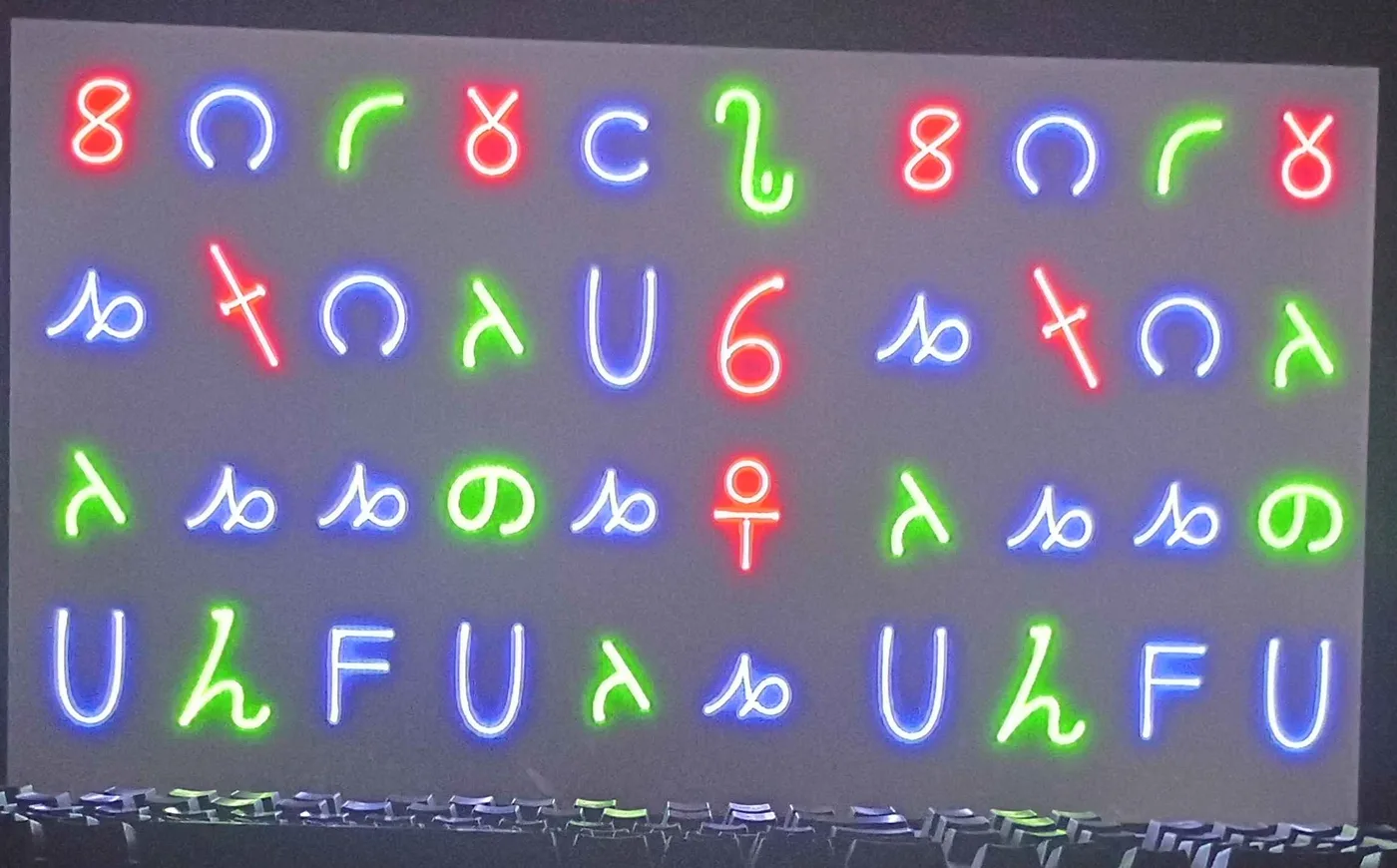 *The decoded panel. The 15 distinct forms are a deliberate mix of scripts, which is what makes them hard to name.*
Two features make it a cipher rather than decoration. The glyphs fall into three color classes of five (red, blue, green), and in every row the last four glyphs repeat the first four, so only the first six per row are independent, giving 24 meaningful positions.
The 15 forms are pulled from several scripts at once, which is the whole difficulty: some read as Japanese kana, some as Latin letters, some as numerals, and others as symbols with no obvious single source. A shape can imitate a character without being it, so the set resists a clean lookup.
We worked out the full substitution, one letter per form. The panel glyphs are hand-drawn, so the table gives the closest printable shape for each; the photo above is the real reference.
| Color | Glyph | Letter |
|---|---|---|
| Red | 8 |
Y |
| Red | four-like mark | H |
| Red | crossed stroke | T |
| Red | 6 |
G |
| Red | circle-and-cross | R |
| Blue | ∩ |
O |
| Blue | C |
A |
| Blue | looped stroke | E |
| Blue | U |
I |
| Blue | F |
S |
| Green | hooked stroke | U |
| Green | 乙 |
V |
| Green | λ |
D |
| Green | の |
P |
| Green | ん |
N |
Reading the 24 independent positions in order gives the panel's message:
Y O U H A V
E T O D I G
D E E P E R
I N S I D E
That is YOU HAVE TO DIG DEEPER INSIDE. Uppercased with no spaces,
YOUHAVETODIGDEEPERINSIDE is the Steghide passphrase for the next stage.
Stage 4: extract and reverse the payload
Steghide, given that passphrase against the recovered BMP, extracts a payload
named vaw (it reports Rijndael-128/CBC, a 32-byte key makes it AES-256-CBC):
steghide extract -sf Major_Tom.bin -p YOUHAVETODIGDEEPERINSIDE -xf vawThe name vaw is wav reversed, and the file's tail reverses into a RIFF/
WAVE header. Reversing the entire byte stream yields a 3.0-second, 44.1 kHz
mono WAV.
Stage 5: read the spectrogram
Rendering the reversed WAV's spectrogram spells the flag body:
ffmpeg -i reversed.wav -lavfi \
  'showspectrumpic=s=1800x800:legend=1:scale=log:mode=combined' \
  -frames:v 1 spectrogram.png
The spectrogram reads Anomolous_Adventures (the misspelling is the author's).
A mark before the closing brace resembles !; the teammate's accepted
submission confirms the flag has no trailing !. The author also confirmed that
brute-forcing the Steghide password was not the intended route. The glyph panel
was.
Takeaway
Depth, not any single trick, is the lesson: five trivial encodings (fragmentation, a byte transform, a visual cipher, Steghide/AES, and an audio spectrogram) compound into something that resists automated carving. For a forensic analyst the takeaway is the inverse: "nothing here" after one pass of the usual tools is not evidence a file is clean.
Flag
Spoiler: show the flag
rowdy{Anomolous_Adventures}